

Concepts: Photophosphorylation and the chemiosmotic hypothesis
Photosynthesis in Higher Plants22 min readLesson 3 of 8
3.1 Two ways to pay for ATP
Photophosphorylation is the name for the formation of ATP in the chloroplast using light energy. The ATP is made in two ways. In non-cyclic photophosphorylation the electron path is open, both photosystems work and the products are ATP, NADPH and oxygen. In cyclic photophosphorylation only PS I works. The electron leaves PS I, passes through ferredoxin, the cytochrome complex and plastocyanin and returns to PS I, so the path is closed. This route makes ATP alone. It happens when the cell needs more ATP than NADPH, which is common when the Calvin cycle is running fast, and it is seen in the stroma lamellae where only PS I is present.
3.1.1 The chemiosmotic hypothesis
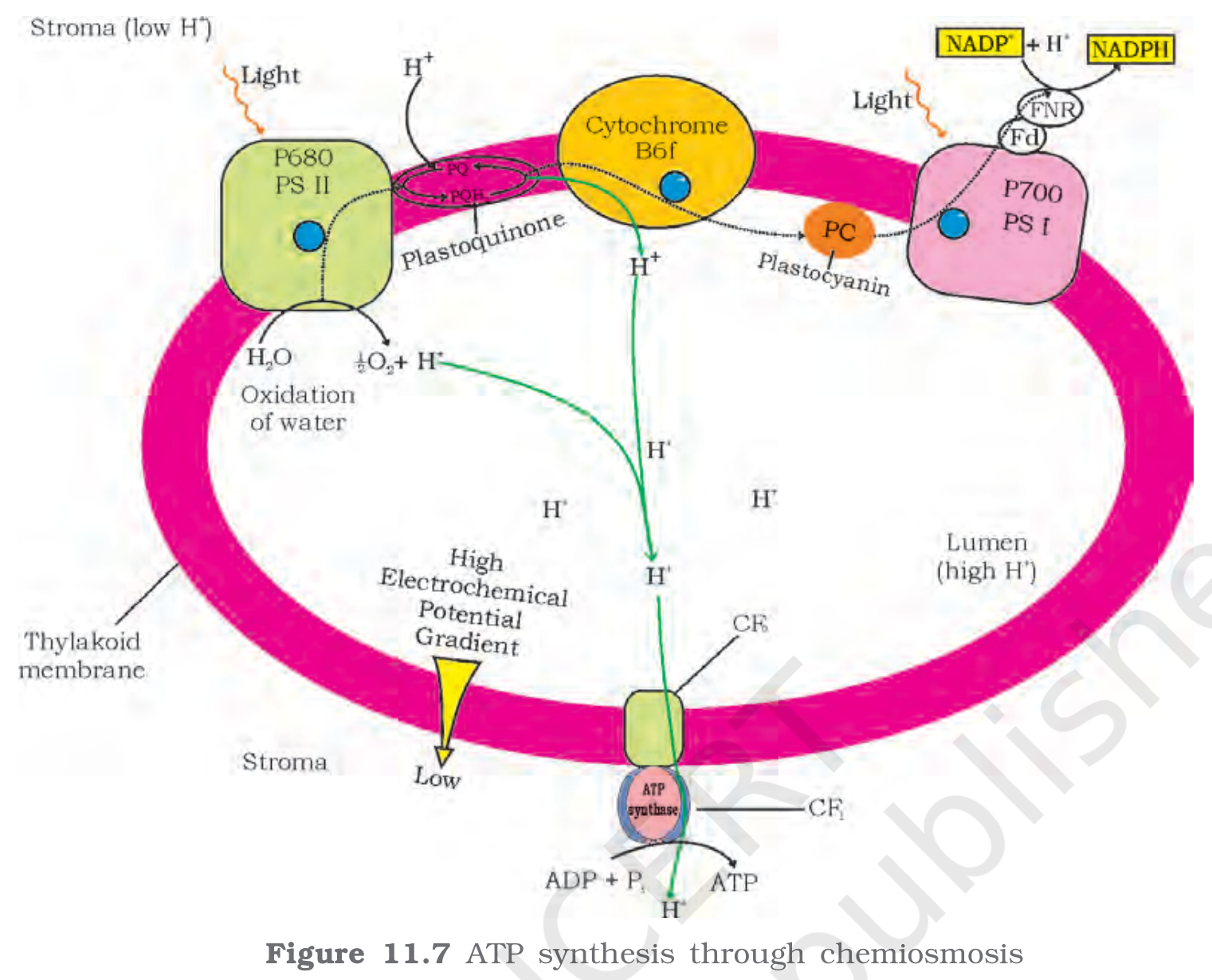
Peter Mitchell proposed that the link between electron transport and ATP formation is a proton gradient. The thylakoid membrane separates the lumen from the stroma, and the light reaction pushes protons into the lumen in three ways. Water splitting releases protons directly into the lumen. As electrons pass through the cytochrome complex, protons are pumped from the stroma into the lumen. Finally, the reduction of NADP+ on the stroma side removes protons from the stroma, which strengthens the difference across the membrane.
The result is a high proton concentration inside the lumen and a low concentration in the stroma. The membrane does not let protons pass through easily, so the gradient is a store of energy. The ATP synthase enzyme spans the membrane and gives protons a route back to the stroma. As protons move down the gradient through the enzyme, the enzyme changes shape and joins ADP and inorganic phosphate into ATP. This is chemiosmosis, and the same logic works in mitochondria, which is a point worth carrying into the respiration chapter.
3.1.2 The ATP synthase machine
The chloroplast ATP synthase has two parts. CF1 is the knob that projects into the stroma and holds the catalytic sites where ATP is made. CF0 is the channel embedded in the thylakoid membrane through which protons pass. The two parts are joined, and the conformational change that drives ATP synthesis happens in CF1.
3.1.3 What limits the light reaction
On a normal day the light reaction is limited by how much light the leaf receives and by how fast the electron carriers can turn over. Excess light can damage the photosystems, so the accessory pigments protect chlorophyll a from photo-oxidation and help dissipate the extra energy. The leaf therefore balances capture of light with protection from too much of it.
3.1.4 Practice from the NCERT exercises, questions 9(b), 9(c) and 9(a)
Exercise 9(a). C3 and C4 pathways differ in the first acceptor and the first stable product. C3 uses RuBP and gives 3-phosphoglycerate as the first stable product. C4 uses PEP and gives oxaloacetate, a four-carbon acid, and the Calvin cycle runs later in the bundle sheath cells.
Exercise 9(b). Cyclic photophosphorylation makes only ATP with only PS I, while non-cyclic photophosphorylation makes ATP, NADPH and oxygen with both photosystems and water splitting.
Exercise 9(c). C3 leaves have ordinary mesophyll without a special sheath, while C4 leaves show Kranz anatomy with bundle sheath cells around the vascular bundles.
A table of the two photophosphorylation routes should carry the entries for the photosystems used, the electron path, the products and whether water is split. Cyclic: PS I only, closed path, ATP only, no water split. Non-cyclic: PS I and PS II, open path from water to NADP+, ATP and NADPH and oxygen, water split.
3.1.5 Why the route matters
The two routes are not alternatives that a leaf chooses at random. When the light reaction is running hard and the Calvin cycle is using NADPH for carbon fixation, some PS I centres continue to work alone, and their electrons return through the carriers. The extra ATP from this cyclic route balances the ATP and NADPH demand of carbon fixation, because the Calvin cycle needs three ATP for every two NADPH. If the leaf could make only non-cyclic products, ATP would fall short of demand.
The products of the light reaction do not travel far. ATP and NADPH are made on the thylakoid membrane facing the stroma, and the Calvin cycle enzymes are in the stroma right next to them, so the two stages are linked by molecules moving a very short distance. This is also why the cycle stops soon after dark: the pool of ATP and NADPH empties, and the cycle has no other supply. Keep the two photophosphorylation routes in one comparison table while revising, because exam questions often ask for both in the same answer.
Exam
A chemiosmosis answer should name the three sources of protons, give the direction of the gradient, name the ATP synthase parts CF0 and CF1, and say where the conformational change happens. The three sources are water splitting, proton pumping by the cytochrome complex and proton removal during NADP+ reduction.
Common mistake
Do not say that the proton gradient is set up in the stroma. The lumen becomes acidic and the stroma stays relatively basic, and ATP synthase lets protons return to the stroma. Do not write that cyclic photophosphorylation makes NADPH. Also do not place ATP synthase in the stroma; its CF0 part is embedded in the thylakoid membrane and only CF1 projects into the stroma.