

Concepts: The Calvin cycle and C3 plants
Photosynthesis in Higher Plants24 min readLesson 4 of 8
4.1 The part that does not need light directly
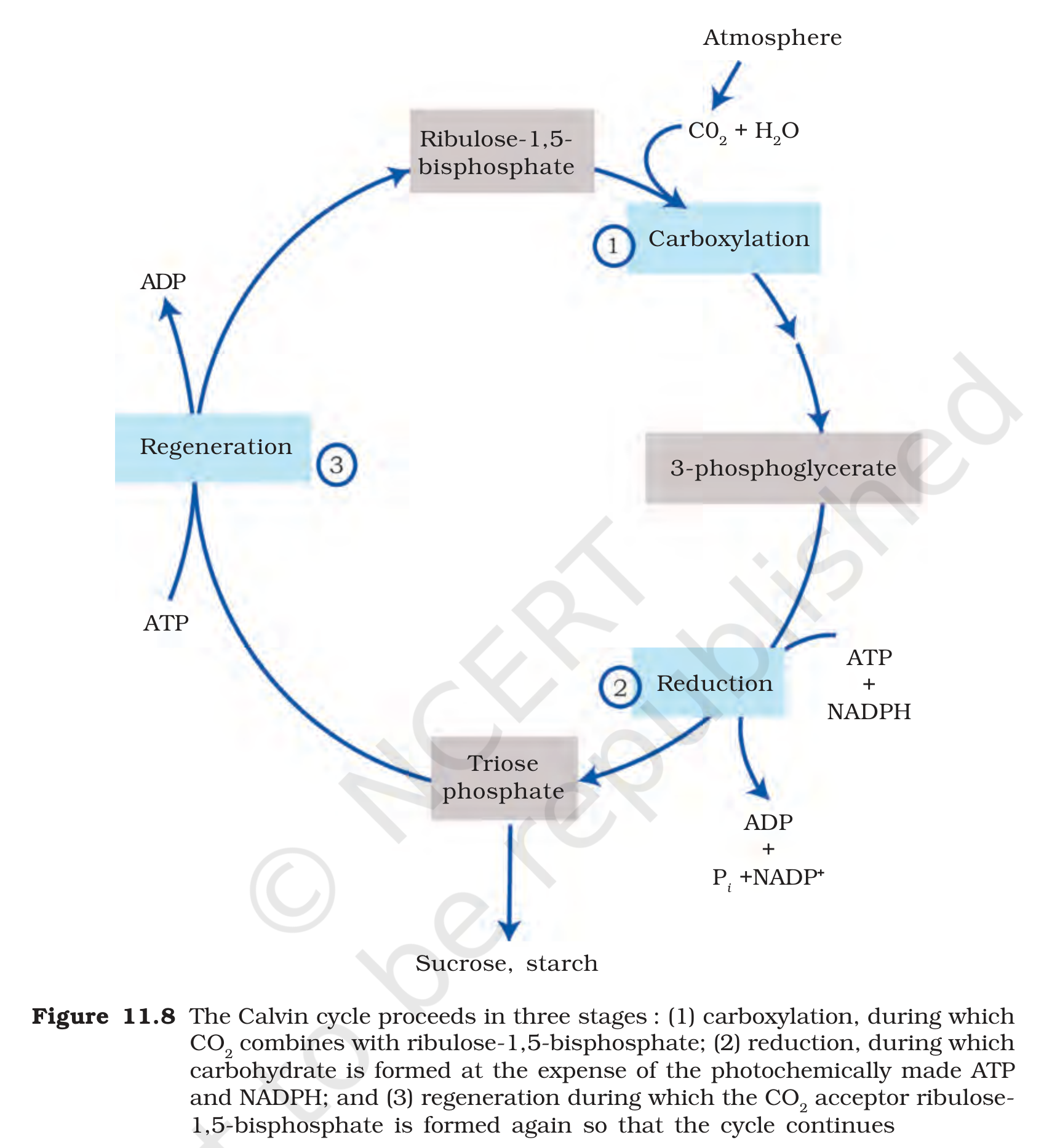
The Calvin cycle runs in the stroma and turns carbon dioxide into sugar. It does not use light directly, but it cannot run for long without the light reaction because it needs the ATP and NADPH made there. The older name dark reaction is misleading: the cycle stops at night because its supplies run out, so it is better called the light independent reaction.
4.1.1 Three stages
Carboxylation is the first stage. Carbon dioxide is joined to a five-carbon sugar phosphate called ribulose bisphosphate, or RuBP, which is the primary acceptor. The enzyme is RuBP carboxylase oxygenase, usually shortened to RuBisCO. One molecule of CO2 plus one RuBP gives two molecules of a three-carbon acid, 3-phosphoglycerate, which is the first stable product of carbon fixation. RuBisCO is a very large enzyme and is thought to be the most abundant protein on earth.
Reduction is the second stage. Each 3-phosphoglycerate uses ATP and NADPH from the light reaction to become glyceraldehyde 3-phosphate, a three-carbon sugar phosphate. For every molecule of CO2 fixed, two molecules of 3-phosphoglycerate are made, and the cycle spends two NADPH and two ATP in the reduction step.
Regeneration is the third stage. Most of the glyceraldehyde 3-phosphate is recycled to rebuild RuBP so that the cycle can continue. Regeneration costs one more ATP for each CO2 fixed. In total the cycle uses three ATP and two NADPH for every molecule of CO2, and six turns of the cycle are needed for one molecule of glucose. Some of the glyceraldehyde phosphate leaves the cycle and is used to make glucose, sucrose and starch.
4.1.2 Who is a C3 plant
A C3 plant fixes carbon directly by the Calvin cycle. The first stable product has three carbon atoms, which is where the name comes from. Rice, wheat, potato and most of the temperate crop plants are C3. RuBisCO in these plants works well when CO2 is high and oxygen is low. On a hot, dry day the stomata close to save water, CO2 inside the leaf falls and oxygen rises, and RuBisCO begins to act as an oxygenase instead. That side reaction leads to photorespiration, covered on the next page.
| Stage | Input | Enzyme or energy | Output |
|---|---|---|---|
| Carboxylation | CO2 + RuBP | RuBisCO | Two 3-phosphoglycerate |
| Reduction | 3-phosphoglycerate + ATP + NADPH | Kinase and dehydrogenase | Glyceraldehyde 3-phosphate |
| Regeneration | Glyceraldehyde 3-phosphate + ATP | Cycle enzymes | RuBP |
4.1.3 Practice from the NCERT exercises, questions 1 to 4
Exercise 1. From the outside alone, a plant cannot be identified as C3 or C4 with confidence. Field signs such as a higher temperature optimum and faster growth in hot, bright conditions suggest C4, but a definite answer needs internal anatomy or the enzyme pattern.
Exercise 2. Internally, a C4 leaf shows Kranz anatomy: a ring of large bundle sheath cells with thick walls and no intercellular spaces around the vascular bundles, with chloroplasts concentrated in those sheath cells. A C3 leaf has ordinary mesophyll without this wreath arrangement.
Exercise 3. In a C4 plant only the bundle sheath cells run the Calvin cycle, yet the plant is highly productive because the mesophyll first pumps CO2 into the sheath cells with PEP carboxylase. RuBisCO in the sheath therefore sees a high CO2 concentration and wastes little carbon through photorespiration.
Exercise 4. RuBisCO acts as a carboxylase when CO2 is plentiful and as an oxygenase when O2 is plentiful. In C4 plants the mesophyll has no RuBisCO, and the bundle sheath is fed a concentrated supply of CO2, so RuBisCO there works mainly as a carboxylase.
4.1.4 What happens to the sugar
Glyceraldehyde 3-phosphate is a three-carbon sugar phosphate, and most of it does not leave the cycle. Regeneration uses ATP to rebuild RuBP from the sugar phosphates, and only a small fraction is drawn off to make glucose, sucrose and starch. This export is the net product of the cycle, and it is why six turns are needed for one glucose molecule: each turn adds one carbon, and six carbons are needed, but at the same time most of the carbon is recycled to keep the acceptor available.
RuBisCO is a large enzyme with several subunits, and it works slowly compared with many other enzymes. To compensate for the slow rate, plants make enormous amounts of it, which is why RuBisCO is regarded as the most abundant protein on earth. The enzyme also accepts oxygen, and that second ability is the reason C3 plants lose carbon on hot days. A short revision check is to redraw the three stages with the inputs and outputs written beside each arrow. Numbering the carbons in the three stages also makes the recycling easy to follow.
Exam
The cost table is a frequent question: three ATP and two NADPH per CO2 fixed, six turns for one glucose. Add the three stage names in order, the acceptor RuBP, the first stable product 3-phosphoglycerate and the enzyme RuBisCO in the same answer. If the question asks where the cycle happens, the answer is the stroma of the chloroplast.
Common mistake
Do not call the Calvin cycle a night reaction. It is light independent, not light requiring, and it stalls in darkness because ATP and NADPH stop arriving. Do not say that CO2 is the acceptor, because RuBP is the acceptor and CO2 is the substrate. Do not mix up the first stable product of C3 (3-phosphoglycerate) with the first product of C4 (oxaloacetate).