

Concepts: The light reaction and the Z scheme
Photosynthesis in Higher Plants24 min readLesson 2 of 8
2.1 Turning light into a chemical signal
The light reaction takes place in the thylakoid membrane and produces three things: ATP, NADPH and an oxygen molecule released from water. The pigments do not sit in a thin scattered layer. They are grouped into a light harvesting complex, a ring of a few hundred pigment molecules bound to proteins, with one reaction centre at the middle. This arrangement is called an antenna system. The antenna pigments absorb photons and pass the energy inward from molecule to molecule by resonance transfer. Only the special chlorophyll a pair at the reaction centre loses an electron to the electron transport chain.
The two photosystems carry the names PS I and PS II. Each has its own reaction centre chlorophyll a, called P700 in PS I because it absorbs best at 700 nm, and P680 in PS II because it absorbs best at 680 nm. PS II comes first in the chain even though its number is higher, a naming quirk worth remembering for exams.
2.1.1 The Z scheme
The path of electrons looks like the letter Z when the redox potentials are plotted on a vertical axis, which is why it is called the Z scheme. Light strikes the PS II antenna, and the P680 pair loses an electron, which travels to pheophytin and then through plastoquinone, the cytochrome complex and plastocyanin to PS I. Along that stretch the electron loses energy, and the energy released pumps protons from the stroma into the thylakoid lumen. A second photon, this time absorbed at PS I, lifts the electron back up. From PS I the electron passes to ferredoxin and finally to NADP+ reductase, which uses two electrons and a proton to reduce NADP+ to NADPH.
The PS II reaction centre replaces its lost electron by taking one from water. A water molecule is split in the thylakoid lumen into two protons, two electrons and one oxygen atom, and two water molecules together give one O2 molecule. The oxygen evolving complex of PS II carries out this splitting, and the electrons released replace those that PS II lost. The protons that are released stay in the lumen and join the proton gradient. This is the only step in the whole of photosynthesis that releases oxygen, and it happens on the inner side of the thylakoid membrane.
2.1.2 Non-cyclic photophosphorylation
When both photosystems work together, the electron path is open from water to NADP+, the electron flow is non-cyclic, and the products are ATP, NADPH and oxygen. This route is called non-cyclic photophosphorylation, and it is the main route on a bright, normal day. Oxygen and NADPH are both made, and the proton gradient drives ATP synthase.
2.1.3 Practice from the NCERT exercises, questions 9(b) and 9(c)
Exercise 9(b). Cyclic photophosphorylation uses only PS I. The electron leaves PS I, passes through the electron transport chain and returns to PS I, so the path is closed. It makes ATP but neither NADPH nor oxygen. Non-cyclic photophosphorylation uses PS II and PS I, splits water, releases oxygen, ends with NADP+ reduction, and makes both ATP and NADPH.
Exercise 9(c). A comparison of leaf anatomy is expected mostly for C3 and C4 plants, and that point is treated on the later pages: C3 leaves have ordinary mesophyll with no specialised sheath arrangement, while C4 leaves have Kranz anatomy with bundle sheath cells wrapped around the vascular bundles.
2.1.4 Two small details that earn marks
The electron carriers sit in a fixed order in the thylakoid membrane, and each one has a different redox potential. The order in the membrane follows the redox scale, so an electron passes downhill from PS II to PS I and then to NADP+. The potential of each carrier is fixed by its protein and its prosthetic group, which is why the scheme is drawn as an energy diagram and not simply as a list.
Pheophytin is the first electron acceptor after P680 and acts as the primary electron acceptor of PS II; plastoquinone then moves electrons and protons across the membrane. On the PS I side, plastocyanin hands electrons from the cytochrome complex to P700, and ferredoxin hands them to NADP+ reductase. The oxygen evolving complex of PS II is the site where water is split into protons, electrons and oxygen. The protons released here add to the gradient, which is why water splitting helps ATP synthesis as well as providing electrons. In an exam answer, that sentence links the two products of the light reaction to the same proton pool.
Slideshow, slide 1 of 3. Use the left and right arrow keys to change slides and the space bar to play or pause.
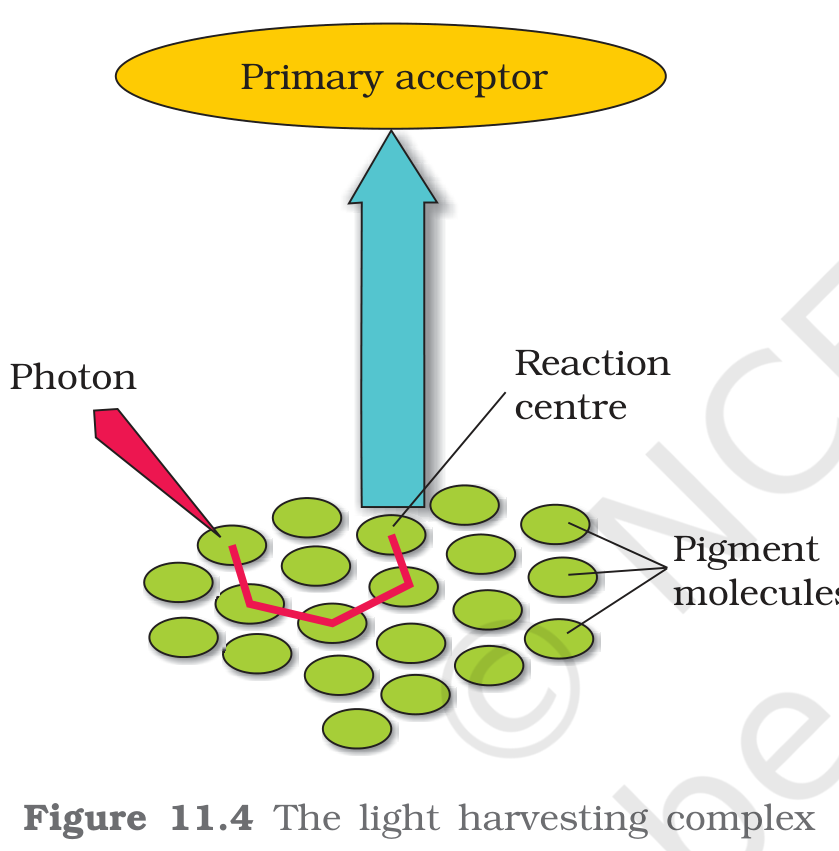
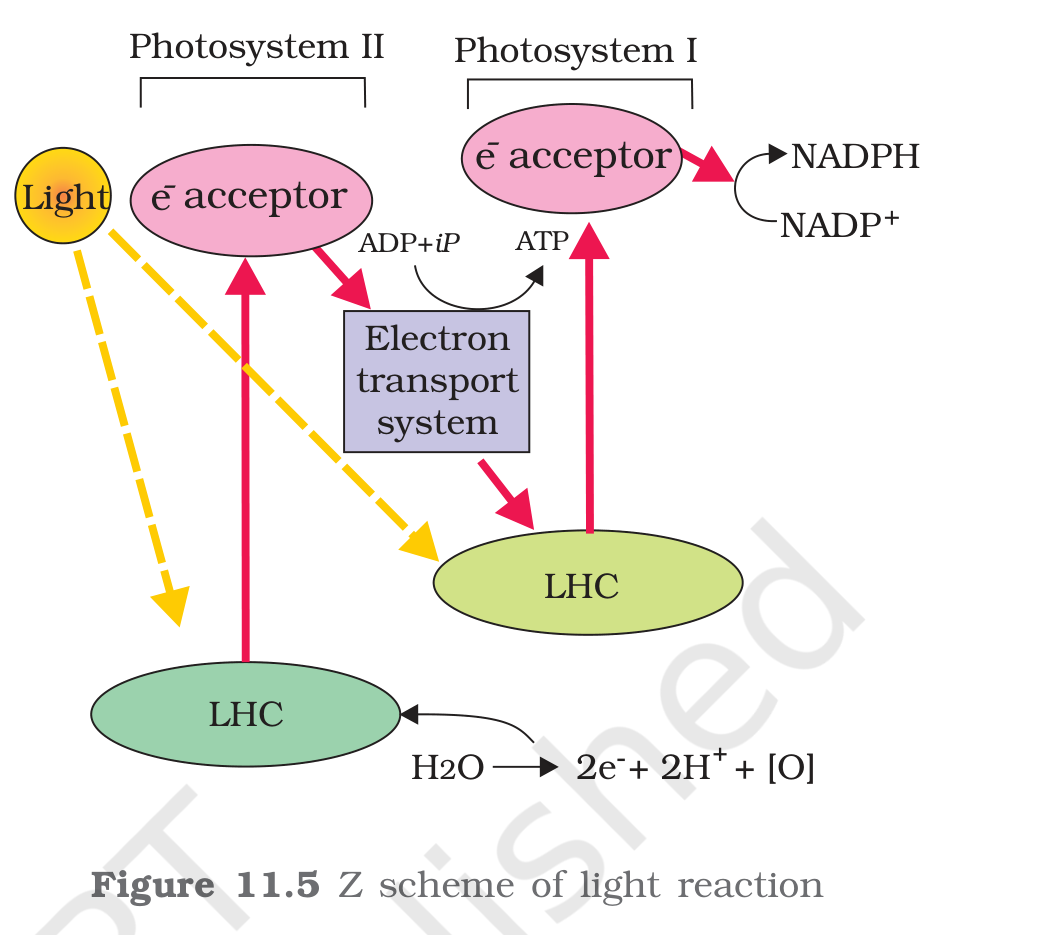
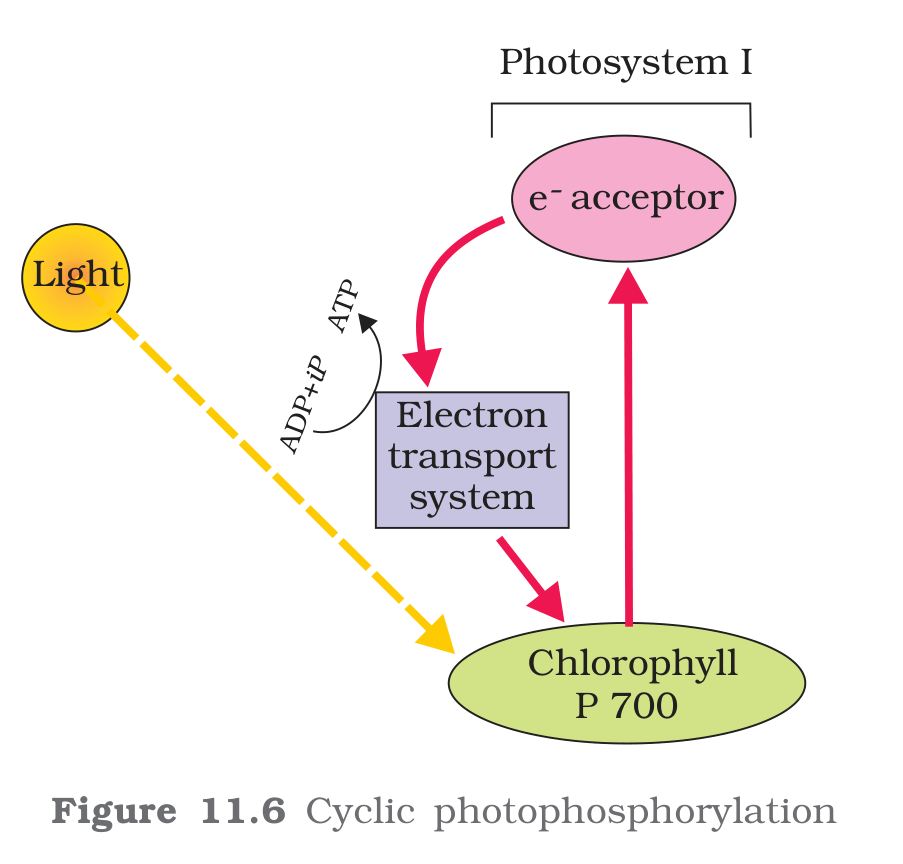
Figure 11.4: the light harvesting complex with pigment molecules arranged around a reaction centre and the primary electron acceptor
Exam
The Z scheme question usually wants the order of carriers, so write PS II, pheophytin, plastoquinone, cytochrome complex, plastocyanin, PS I, ferredoxin and NADP+ reductase. Add the two light inputs, one at each photosystem, and state clearly that water is split at PS II and NADP+ is reduced at the end of PS I. For the location, the whole chain sits in the thylakoid membrane.
Common mistake
Do not start the chain at PS I just because its name comes first: PS II supplies the electron that eventually reaches PS I. Do not say that PS I splits water; water splitting belongs to PS II and to the oxygen evolving complex. Also keep the two products of the light reaction separate from sugar, because sugar is made only later in the Calvin cycle.