Electric current and its magnetic effect
Electricity: Magnetic and Heating Effects13 min readLesson 1 of 5
1.1 A crane with no magnet
The chapter opens at a school science exhibition. Two students, Mohini and Aakarsh, stop at a working model made by their senior Sumana. It looks like a crane, but instead of a hook it has an iron nail wrapped with wire, and the wire is connected to a battery. When Sumana closes the switch, the nail picks up iron paper clips. When she opens the switch, the clips fall off.
The two students are puzzled. They know that iron is attracted by a magnet, but there is no magnet in the model, only a circuit. Their surprise is the starting point of the chapter: an electric current can behave like a magnet.
The chapter's opening questions follow the same theme. Can a current be detected without a lamp? Can temporary magnets be made? How does an electric appliance produce heat? How do we know when a cell is dead, and can every battery be recharged?
1.2 A compass beside a wire
The first activity builds a simple circuit with a cell, a switch and a wire stretched between two nails on cardboard. A magnetic compass is placed below the wire. With the switch off, the compass points in its usual direction. When the switch is turned on, the needle swings away from its direction. When the switch is turned off again, the needle returns.
The moving needle tells us that something around the wire changed while current was flowing. A compass needle is itself a tiny magnet, and it turns when a magnetic effect reaches it. Magnetic field is the name for the space around a magnet or a wire carrying current within which its magnetic pull can be detected. The field exists only while the current flows; when the current stops, the field disappears and the needle comes back. Current flowing through a conductor therefore produces a magnetic field, and this is called the magnetic effect of electric current.
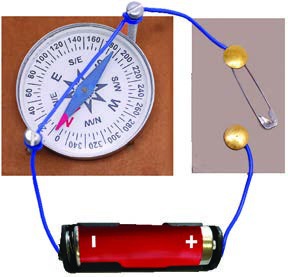
1.3 Oersted's accidental discovery
The same observation was made in 1820 by Hans Christian Oersted, a professor in Denmark. During a demonstration he noticed that a compass needle nearby jumped whenever a circuit was closed or opened. He investigated the effect carefully and published his finding once he was sure that a current really does produce a magnetic field. Other scientists repeated his experiment, and the link between electricity and magnetism became a new field of study.
Oersted's story shows how a small, unexpected observation can become a major discovery when it is followed up with careful experiments. A deflected needle looks like a small thing; recognising that it means a hidden field is what made the observation important.
1.4 Where the magnetic effect is used
The magnetic effect of current is busy all around us. Electromagnets, electric bells, motors, fans and loudspeakers all depend on it. A doorbell that rings when a button is pressed, a fan that spins when switched on, and a speaker that turns an electrical signal into sound all use a current-carrying coil and a magnetic field. The next page takes the electromagnet apart and shows how to make one stronger.
1.5 Reading the experiment carefully
The compass experiment has a few details worth noticing. The needle does not swing because the wire pushes it physically; the wire and the compass are not touching. The needle responds to a field that reaches it through the air and through the cardboard. That is why placing a non-magnetic material between the wire and the compass does not block the effect.
The deflection also depends on the direction of the current. If the cell connections are reversed, the needle deflects the other way. When the current stops, the needle settles back to its original direction. These three observations, deflection on switching on, reversal on reversing the current, and return on switching off, together confirm that the magnetic effect belongs to the current and not to the wire itself.
1.6 Why the needle matters
A magnetic field is invisible, but it is not imaginary. The compass needle gives evidence of it, just as a thermometer gives evidence of temperature. The needle is a small magnet that can turn freely, so it lines up with the magnetic pull around it. When the wire's field is present, the needle swings to a new direction; when the field is gone, the needle returns to the Earth's north-south direction.
The field around a current-carrying wire is not the same at every distance. Its effect is stronger near the wire and weaker farther away, which is why the compass has to be placed close to the wire for the deflection to be clear. The field also passes through paper, cardboard and many other non-magnetic materials, so the effect can reach the needle even when a sheet of cardboard lies between them.
1.7 From the classroom to technology
Once the link between current and magnetism is understood, many devices follow from it. An electric bell uses an electromagnet to pull a hammer towards a gong; a motor uses a magnetic field to turn a coil; a fan uses a motor to spin its blades; and a loudspeaker uses a coil moving in a magnetic field to create sound. In each case, the magnetic effect is controlled by switching the current.
The same idea has a much larger application in lifting electromagnets, which move tons of scrap metal in scrapyards. The operator does not need to tie or unhook the load. Switching the current off releases the metal, which makes the process fast and safe when handled correctly.