

Electromagnets and their uses
Electricity: Magnetic and Heating Effects14 min readLesson 2 of 5
2.1 A temporary magnet
An electromagnet is made by winding insulated wire into a coil and passing a current through it. In the first version of this experiment, about 50 cm of wire is wrapped tightly around an iron nail and the ends are connected to a cell. The nail is brought near iron paper clips, and the clips cling. When the wire is disconnected, the clips fall.
The coil must only be kept connected briefly, for a few seconds at a time, because a small cell weakens quickly. That caution is part of the experiment: a cell is a limited source, and a long wire across its terminals can drain it.
2.2 A coil, two compasses and an iron core
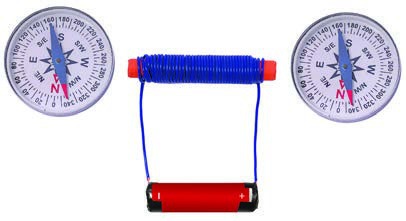
The next activity makes the effect easier to study. About 100 cm of wire is wound as 50 turns around a paper cylinder, and two compasses are placed near the two ends. When the coil is connected to the cell, both needles deflect. When the connection is broken, they return. The coil, in other words, is acting like a magnet.
Now an iron nail is inserted into the paper cylinder and the test is repeated. The deflection becomes much larger, and the coil can pick up iron clips. The iron core concentrates and strengthens the magnetic effect. For practical use, most electromagnets therefore contain an iron core. A coil that acts as a magnet while current passes through it is an electromagnet.
2.3 Poles and strength
An electromagnet has two poles, north and south, just as a bar magnet does. The poles can be identified with a compass: if the north pole of the compass is attracted to one end of the coil, that end is the south pole of the electromagnet. The other end will be the north pole. Reversing the direction of the current swaps the poles.
You can alter an electromagnet's strength in two main ways. Passing a larger current, for example by using more cells in the battery, makes the field stronger, so the compass deflects more and the coil lifts more clips. Increasing the number of turns of wire also makes the magnet stronger. Both changes can be combined.
2.4 Earth as a giant magnet
A freely suspended magnet comes to rest pointing north and south because the Earth itself has a magnetic field. Deep inside the planet, movement of liquid iron creates electric currents, and these currents generate the field. Migratory birds, fish and other animals use the field to navigate, and the magnetic shield around the Earth blocks harmful particles arriving from space.
2.5 Lifting electromagnets
A strong electromagnet can be hung from a crane and used as a lifting device. With the current on, the magnet grips iron and steel; cutting the current makes the field disappear and the load drops. Crane operators use these lifting electromagnets in factories and scrapyards to move, lift and sort heavy metal. The ability to switch the magnetism on and off is what makes an electromagnet more convenient than a permanent magnet for this job.
The same principle appears in smaller machines. A doorbell uses an electromagnet to pull a hammer against a gong, a motor uses magnetic fields to turn a shaft, and a loudspeaker uses a coil moving in a magnetic field to produce sound. The chapter gives a hint of what comes next in higher classes: the reverse also works, because moving a magnet near a coil can drive a current, and that two-way link underlies motors and generators.
2.6 Comparing permanent and electromagnets
| Feature | Permanent magnet | Electromagnet |
|---|---|---|
| Magnetic effect | Always present | Present only while current flows |
| Strength | Fixed by the material | Can be changed with current and turns |
| Poles | Fixed | Can be reversed by reversing current |
| Common use | Compass, fridge magnet | Crane, bell, motor, loudspeaker |
The table makes the main difference clear. A permanent magnet is convenient when a steady field is needed, while an electromagnet is useful when the field must be switched, varied or reversed.
2.7 Testing strength with more cells and turns
The chapter suggests repeating the coil experiment in two ways: with 2 or 4 cells but the same coil, and with 2 cells but a different number of turns. Both changes increase the magnetic effect. One cell provides only a small current, so the field is weak, the compass deflection is small and only a few clips cling to the coil. A battery with more cells drives a larger current, which creates a stronger field, a larger deflection and a bigger load of clips.
Changing the number of turns has the same direction of effect. More turns of wire around the core produce a stronger magnet for the same current. In a real electromagnet, the current and the number of turns can be chosen together, which is why the strength can be tuned to the job. Too much current, however, can overheat the coil, so practical designs balance strength against safety.
2.8 Poles are not fixed
A permanent magnet keeps the same poles, but an electromagnet does not. In the coil experiment, compasses near the two ends show that one end behaves as a north pole and the other as a south pole. If the battery connections are swapped, the poles swap as well. This is why an electromagnet is useful in a motor or a reversing mechanism, where the direction of the magnetic push has to change. The same coil can pull in one direction with the current one way and in the opposite direction with the current reversed.